Pearson Edexcel · A-Level · Economics B
Course version: 9EB0 · Version from Sept 2015
A) Different business objectives and reasons for them: o profit…
Full specification wording
Business objectives: a) Different business objectives and reasons for them: o profit maximisation o sales maximisation o satisficing
Businesses pursue different objectives depending on their size, ownership, and market conditions.
Checked against the Pearson Edexcel 9EB0 specification (opens in a new tab) on .
- Point 1 of 2
- 4 key terms
Study notes
From the checked teaching notes for this specification point.
The idea
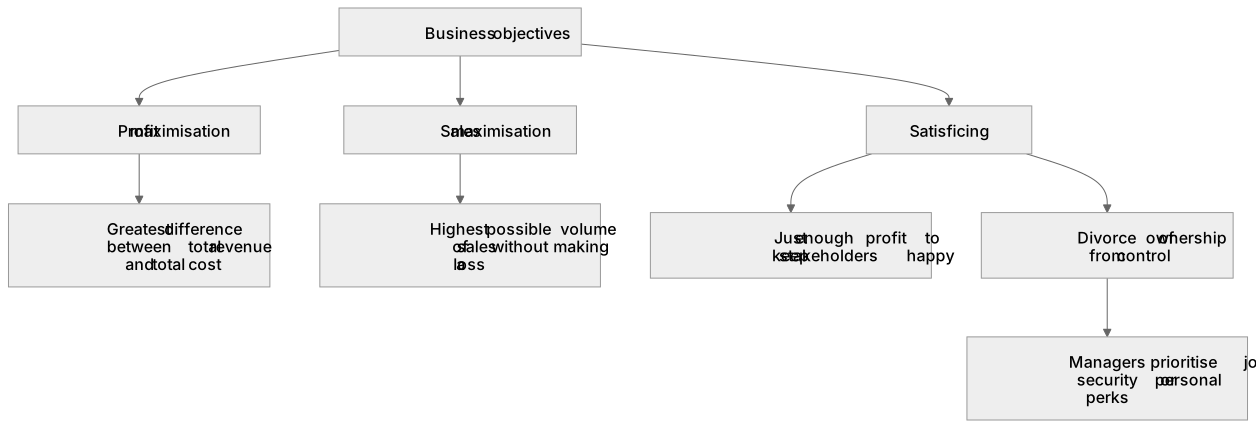
Businesses pursue different objectives depending on their size, ownership, and market conditions. Profit maximisation occurs when the difference between total revenue and total cost is greatest; this is often the primary goal to satisfy shareholders and fund reinvestment. Sales maximisation focuses on achieving the highest possible volume of sales without making a loss, often used to increase market share or benefit from economies of scale. Satisficing involves making just enough profit to keep stakeholders happy while pursuing other goals. This often occurs where there is a divorce of ownership from control, leading managers to prioritise their own job security or personal perks over achieving maximum profits for the shareholders.
What earns the marks
- Identification of profit maximisation as the greatest difference between total revenue and total cost.
- Explanation of sales maximisation as increasing volume to gain market share or economies of scale.
- Definition of satisficing as achieving a minimum acceptable level of profit to satisfy stakeholders.
- Linking satisficing to the principal-agent problem or divorce of ownership from control.
Common mistakes and how to put them right
Confusing sales maximisation with revenue maximisation.
Put it right: Sales maximisation focuses on the volume of goods sold, whereas revenue maximisation focuses on the total value of sales.
Assuming all businesses aim to maximise profit.
Put it right: Many businesses, especially smaller ones or those with a divorce of ownership and control, may satisfice or pursue other objectives.
Misunderstanding satisficing as making no profit.
Put it right: Satisficing involves making enough profit to satisfy shareholders while pursuing other managerial goals.
Exam tips
- Clearly distinguish between the motives for profit maximisation and sales maximisation.
- Use the concept of the principal-agent problem when explaining why a firm might choose to satisfice.
- Be ready to apply these objectives to a case study, identifying which objective a specific business is likely pursuing based on the text.
Try the lesson
The start of the Business objectives: a) Different business objectives and reasons for them: o profit maximisation o sales maximisation o satisficing lesson, made from checked teaching notes for this specification point.
Have a go first
Which of the following best defines the business objective of satisficing?
Listen
Businesses pursue different objectives depending on their size, ownership, and market conditions. Profit maximisation occurs when the difference between total revenue and total cost is greatest; this is often the primary goal to satisfy shareholders and fund reinvestment. Sales maximisation focuses on achieving the highest possible volume of sales without making a loss, often used to increase market share or benefit from economies of scale. Satisficing involves making just enough profit to keep stakeholders happy while pursuing other goals. This often occurs where there is a divorce of ownership from control, leading managers to prioritise their own job security or personal perks over achieving maximum profits for the shareholders. A strong answer earns marks for these points. Identification of profit maximisation as the greatest difference between total revenue and total cost. Explanation of sales maximisation as increasing volume to gain market share or economies of scale. Definition of satisficing as achieving a minimum acceptable level of profit to satisfy stakeholders. Linking satisficing to the principal-agent problem or divorce of ownership from control. A common slip: Confusing sales maximisation with revenue maximisation. Instead, Sales maximisation focuses on the volume of goods sold, whereas revenue maximisation focuses on the total value of sales. Exam tip: Clearly distinguish between the motives for profit maximisation and sales maximisation.
See it
Key words
Say what each word means before you turn the card.
Profit maximisation
Try answering aloud or in your head before turning the card.
Sales maximisation
Try answering aloud or in your head before turning the card.
Satisficing
Try answering aloud or in your head before turning the card.
Principal-agent problem
Try answering aloud or in your head before turning the card.
See every definition
- Profit maximisation
- Occurs when the difference between total revenue and total cost is greatest, often the primary goal to satisfy shareholders and fund reinvestment.
- Sales maximisation
- Focuses on achieving the highest possible volume of sales without making a loss, often used to increase market share or benefit from economies of scale.
- Satisficing
- Involves making just enough profit to keep stakeholders happy while pursuing other goals.
- Principal-agent problem
- Arises where there is a divorce of ownership from control, leading managers to prioritise their own job security or personal perks over achieving maximum profits for the shareholders.
Label the diagram
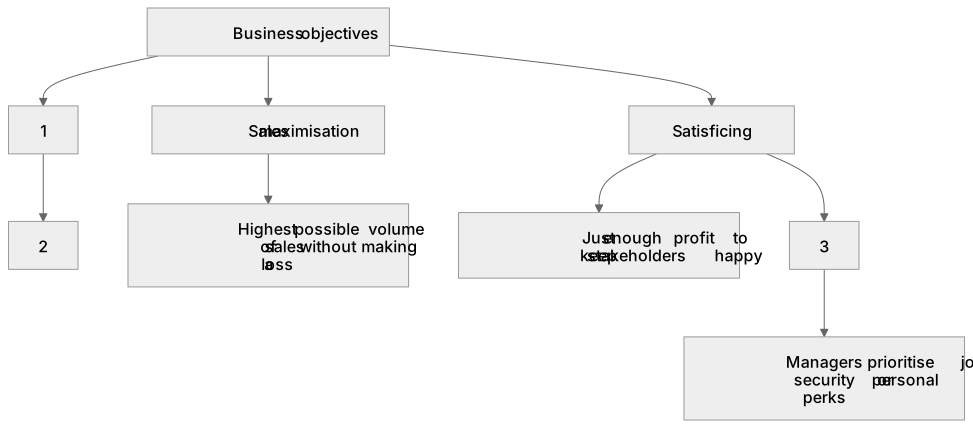
Some boxes have lost their names. Pick the right name for each number.
1Box 1
2Box 2
3Box 3
There is more to this lesson
The full lesson goes on to check your understanding and help you earn the marks. Create a free account to carry on, with your progress saved.
A week of Premium from your first lesson · Then the free plan continues · No card, no charge
Test your understanding of Business objectives: a) Different business objectives and reasons for them: o profit maximisation o sales maximisation o satisficing
Active recall beats re-reading. Take an instant quiz now to test what you’ve learned and lock it into long-term memory.
A week of Premium from your first lesson · Then the free plan continues · No card, no charge